Blog · Guides
How AI RFP tools avoid making things up, and where they still can
The good ones draft only from your sources, cite every claim, and hand the questions they cannot support to a person. Here is how that works, what we saw when we tested our own account, and the three places a made-up answer can still get through.
 Thomas KrawczykVP Marketing, Tribble · Published · 9 min read
See what happens when there is no source. Our team will show you how Tribble cites every answer and routes the questions your sources cannot support to the expert who owns them.
AI RFP tools avoid made-up answers in three ways. They draft only from your approved sources. They show the source beside every claim. And they send the questions those sources cannot support to a person, instead of filling the gap with something plausible. They can still go wrong in three places: when the source itself is wrong, when a draft stretches a true source to cover a different question, and when a reviewer approves a confident draft without opening the citation.
A made-up answer on a security questionnaire is not a typo. It is a claim your company signs, which is why buyers raise it so often. It came up in 6 of the 28 prospect calls we reviewed from July to October 2026.
Why general AI tools make things up on an RFP
A language model asked a question will produce an answer. That is what it is built to do. If it has no source in front of it, it writes the reply that sounds most likely, and on an RFP the reply that sounds most likely is often the one the buyer wants to hear.
Take "Do you hold a current FedRAMP Moderate authorization?" Plenty of software vendors that sell to US government agencies do, so yes is a plausible-sounding answer. For your company it may be false. A chatbot cannot tell the difference between what is typical and what is true for you, and the result reads exactly like a fact.
That is why pasting RFP questions into a general chatbot is risky for anything factual. It is fine for tightening a paragraph. It is not fine for a claim about your controls, your certifications or your contract terms.
Three controls that stop most made-up answers
Draft only from your sources
The first control is to make the tool find the evidence before it writes. An AI RFP tool searches your approved documents for the passages that answer the question, then drafts from those passages only. If nothing relevant comes back, there is nothing to draft from, which is the signal you want.
Show the source beside every claim
The second control is a citation you can open. Not a list of documents at the bottom, but a marker on each sentence that opens the exact passage, the document it sits in, who owns it and when it was approved.
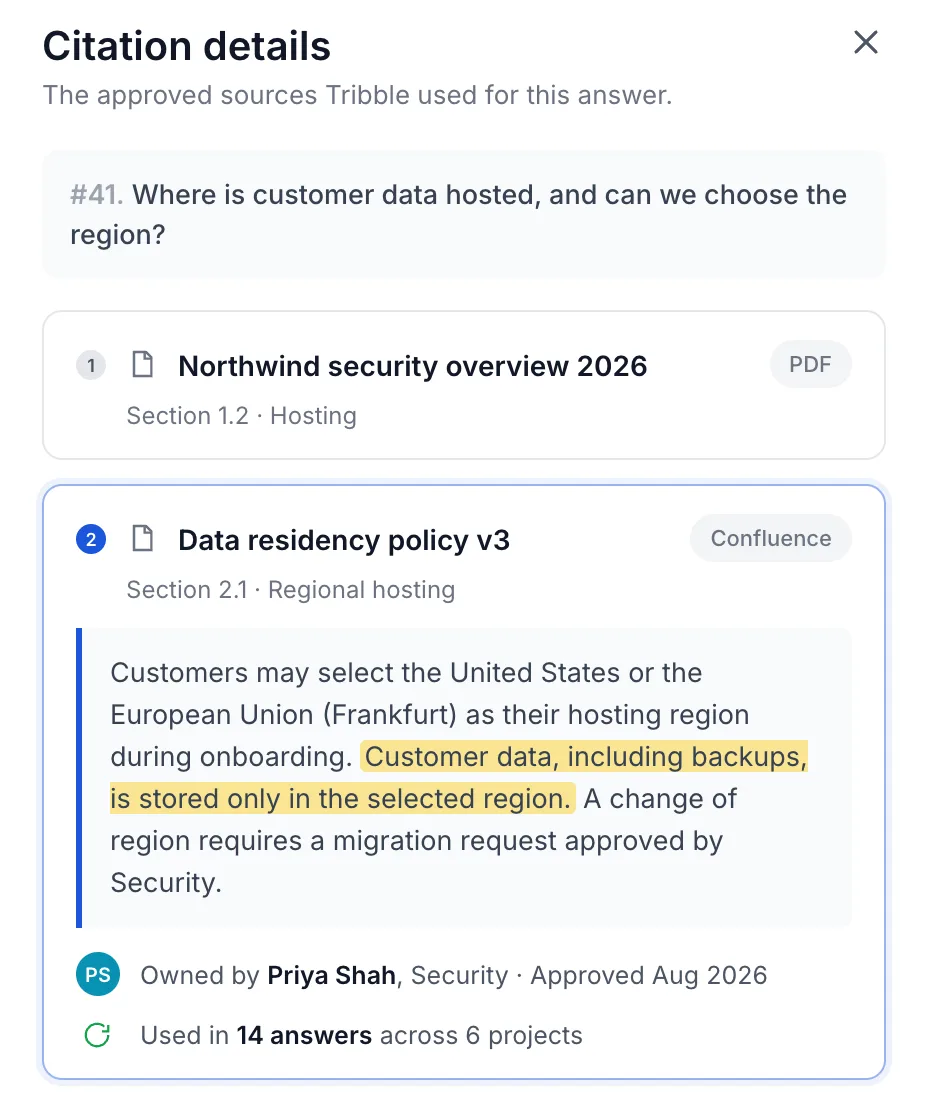
This is what makes review fast. A reviewer who can see the passage checks a claim in seconds. A reviewer who has to go looking for it either takes the time or trusts the draft.
Route what the sources cannot support
The third control matters most. When the sources do not support an answer, the tool should not try. It should leave the question open and send it to the person who knows.
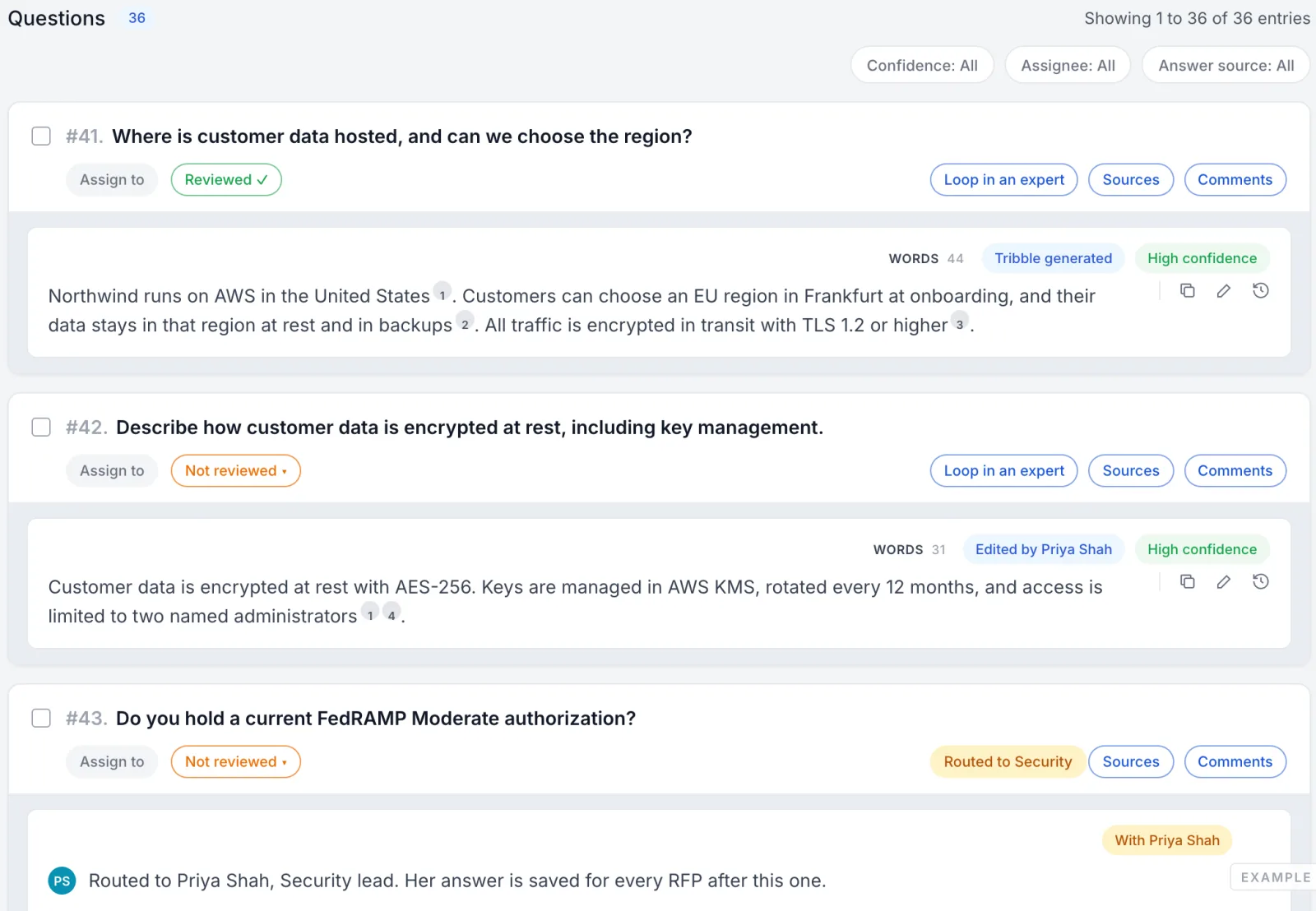
In that screen, Tribble drafted the hosting answer from cited sources, the security lead's edit to the encryption answer kept its citations, and both carry high confidence. The FedRAMP question had no source behind it, so Tribble routed it to the security lead. When she answers, her answer is saved with its source, and the next RFP that asks gets it.
Buyers tell us this is the behaviour they want. One RFP team asked us whether the tool would guess at an answer it had no source for. When they heard it leaves a "needs input" placeholder instead, their reply was that this was "the preference instead of making it up."
See an unanswerable question get routed. We will show you what Tribble does with a question none of your sources can support.
What Clari's review number really says
Clari's sales engineering and security teams answer RFPs and detailed security questionnaires from one set of approved sources in Tribble. Two of their published results:
 90% of a 200-question RFP completed in under an hour
- 10-20% of security responses needed specialist review
The second number is the one to read closely. In Clari's own account, high-confidence answers moved quickly, and the remaining 10 to 20% of security responses stayed with the right reviewer for specialist attention. Read it as where the specialists' time went. It does not say the rest went out unchecked.
I completed 90% of a 200-question RFP in just an hour, and it handles one-off technical questions from sales with incredible accuracy.
Shaundra Toy, Sales Engineer, Clari
That matches what experienced bid teams expect. A senior bid response manager told us in October that they are "always going to want people involved," with "layers of redundancy and review." Treat the split as a benchmark in your own evaluation: if a tool claims nothing needs review, it is either working from a narrow set of questions or not telling you what it guessed.
Where a made-up answer can still get through
No tool makes this risk zero, and you should be wary of one that says it does. Three gaps remain.
- The source is wrong. A tool that drafts faithfully from an out-of-date policy produces a confident, cited, wrong answer. Citations prove where an answer came from, not that the source is current. That is a source ownership problem, covered in how to keep RFP answers current.
- The answer stretches the source. A passage saying "customer data is encrypted at rest with AES-256" truly answers "do you encrypt data at rest?" It does not answer "do customers manage their own encryption keys?", but the words overlap, and a draft can stretch one into the other. Confidence scores are built on how closely the source matches the question, so a stretch can still score high. Read the passage, not just the score.
- The review is a rubber stamp. If reviewers approve high-confidence answers without opening a single citation, the controls above stop helping. Tribble can block export until every answer has been reviewed, but no setting makes someone read.
Five tests for made-up answers
Each of these takes a few minutes during a trial and tells you more than any accuracy percentage on a vendor's website.
- Ask a question you know the answer to is no, such as a certification you do not hold. The right result is a routed question or a sourced no, never a confident yes.
- Ask one step beyond a source. Pick a policy and ask something it nearly covers. Watch whether the draft stretches.
- Open five citations at random and read the passage. Does it say what the answer says?
- Ask something no source covers and see where the question goes. It should reach a person with a name, not come back as a confident draft.
- Ask how the confidence score is worked out, and what the tool does with a low score.
What happened when we ran three of them on ourselves
On October 19, 2026, we asked three of these questions about ourselves, on our own Tribble account, phrased as a buyer would phrase them in an RFP.
| Test | What we asked | What came back |
|---|---|---|
| The true answer is no | Does Tribble hold a current FedRAMP Moderate authorization? | Said our approved sources do not support a yes, and gave none |
| One step beyond a source | Can customers manage their own encryption keys? | Answered from our key management source, which says how keys are actually managed, instead of stretching the encryption at rest passage into a yes |
| No source covers it | What is the most SAML identity providers one tenant can configure at once? | Gave the single sign-on facts it had sources for, and said no source states a limit |
None of the three came back with a guess. What this does not show: tests 3 and 5 need a live project with citations and confidence scores in front of you, and a chat answer shows neither. Run those in your own trial.
FAQ
Questions buyers ask
Do AI RFP tools hallucinate?
General chatbots do, because they write a plausible answer whether or not they have a source. AI RFP tools that draft only from your approved sources, cite every claim and route unsupported questions to a person are much less likely to invent one. They can still repeat a wrong source or stretch a true one, so review stays.
How accurate are AI-generated RFP responses?
As accurate as the sources they draft from and the review behind them. Accuracy percentages on vendor websites depend on the questions tested. A more useful measure is how many answers need specialist review: at Clari, 10-20% of security responses needed specialist review, and high-confidence answers moved quickly.
How much of an AI-drafted RFP still needs human review?
Every answer should get at least a quick check against its citation before it goes to a buyer. The share that needs real judgment from a specialist is smaller. Clari's was 10-20% of security responses. Expect a higher share at first, and a lower one as experts' answers are saved for reuse.
What is a confidence score in RFP software?
A confidence score estimates how well the retrieved sources support a drafted answer. A high score means the sources closely match the question. It is a guide for where to look first, not proof that an answer is right, because a source can match the words of a question without answering it.
Is it safe to use ChatGPT to answer RFPs?
It is fine for editing prose you have already checked. It is risky for factual answers about your security, certifications or contracts, because it has no access to your approved sources and will produce a plausible answer anyway. Use a tool that drafts from your documents and shows the source.
See where every answer comes from
In a demo, you will see Tribble draft from your approved sources, show the passage behind every sentence, and route what it cannot answer to the right expert.
Book a demo★★★★★ Rated 4.7/5 on G2 (Source: G2.com, Inc.)